What it’s like to compete – and medal – at the taekwon-do world championships as a journalist
As we walk from an arena where we just competed to our hotel, the question is casually asked to my teammate who is more than five years younger than me. I stay silent and try to hold a blank.
What it’s like to compete – and medal – at the taekwon-do world championships as a journalist
Updated: April 15, 2026
As we walk from an arena where we just competed to our hotel, the question is casually asked to my teammate who is more than five years younger than me.
I stay silent and try to hold a blank expression to hide any potential wrinkles. It’s hard enough not to think about the fact that I’m almost 20 years older than many of my opponents.
For the past five years, I’ve been part of the English National Team in the International Taekwon-Do Federation (ITF). The hyphen in ‘taekwon-do’ distinguishes our martial art from World Taekwondo, which is the Olympic sport.
Looking up ITF Taekwon-Do, it is often described as the traditional form of taekwondo, with a focus on self-defense – tell that to my teammates who knock people out in competitions.
We may be living in the shadow of Olympic taekwondo, but with hundreds of thousands of practitioners worldwide, we’re a fully fledged sport with our own championships and world-class athletes performing at the highest level.
The mental prep
The day I was encouraged to try out for England’s National Team, I couldn’t believe it. Training in other places in Europe, I was never on anyone’s radar as someone who had potential. I felt like I was too old even at the time, but figured I might as well try to see if I was now finally at an acceptable level.
If the requirements then had been as strict as they are today, I would probably never have made it, but the coaches saw potential and were willing to take a chance on me – belief is so important to get anywhere in life.
Michal Dziubicki, Ahlskog Hou’s husband and coach, knows the importance of raising her spirits and maintaining her focus before she goes into the match. Courtesy Marcin Doniesiewicz
Fast forward five years and I’ve earned my place in the team every year since, medaled as both an individual and in team competition at the European Championships, and won a number of national and international competitions.
But previous laurels don’t stop me from feeling like I’m about to be wiped out every time I go onto the mats. The 2025 World Championships were the second in my career and something I’d been looking forward to up until the final weeks before the competition, when reality kicks in and the grind ramps up.
The draws
Roughly two weeks before the tournament, the draws come out. Checking draws is a nerve-wracking moment, unless you’re a multi-time world champion, I guess. The vast majority – like me – do this as a hobby alongside a full-time job, studying, or both. But there are some people who have grown up doing this sport and are able to do it almost full-time, either through sponsorships or alongside teaching.
“I’m not checking the draws. You’re going to have to win over all of them anyway,” a teammate told me. While I admire her attitude, I check my draw anyway.
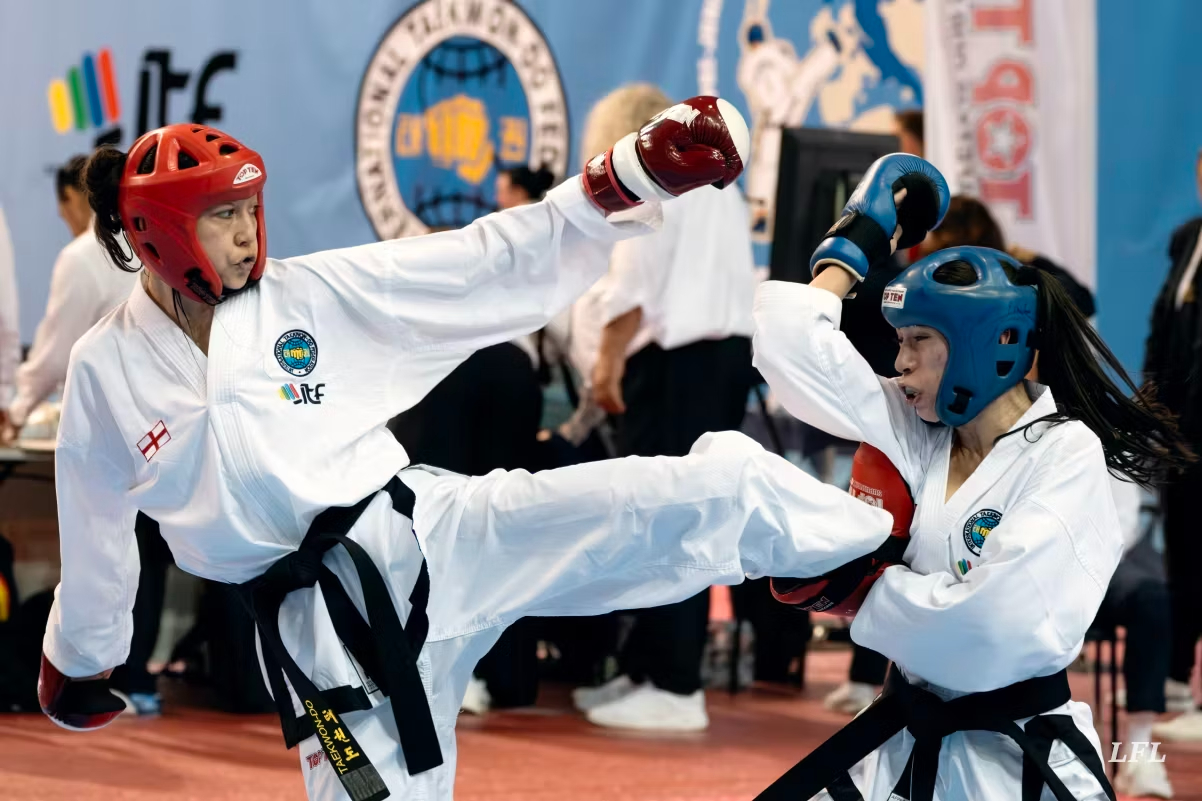
ITF taekwon-do may be living in the shadow of Olympic taekwondo, but with hundreds of thousands of practitioners worldwide, it’s a fully fledged sport with its own championships. Li-Lian Ahlskog Hou/CNN
My first fight – which may well be the only fight – is against Poland. I’ve never won an individual sparring match against a competitor from Poland. They used to sponsor their competitors – I know this because my husband Michal was one of their professional athletes – and in general, their fighters are solid, highly skilled and have an element of fearlessness to them that I’m certainly lacking. The Polish woman I faced a few years ago “wiped the floor with me,” as my dear husband described it.
The next fight in the draws: a multi-time European and world champion from Germany and probaby the best person in my category. I saw her winning the European Championships earlier this year and I thought, “Thank God, I didn’t have to face her.”
Michal, who doubles as my coach, and I look no further than the second round. It’s good to be positive, but it’s important to stay realistic – it’s single elimination, meaning once you’ve lost a match, you’re out. What does this mean? Sometimes, it means you’ve taken a week off work or school and prepared for months, or years, to literally compete for four minutes.
Seeing my draw while already feeling weak due to my weight cut is not exactly raising my spirits. The couple of weeks before heading off, I’m constantly tired, hungry and massively dispirited every time someone asks, “Ready for your championships?!”
Even though she’s competed for years, Ahlskog Hou always feels tense when she steps onto the mats. Courtesy Marcin Doniesiewicz
I’m also battling an injury, making it impossible to train as much as I would need, and work with CNN is more demanding than ever. The thought of pulling out crosses my mind more than a few times.
The tournament is in Poreč in Croatia. Two days before worlds kick off, Michal and I fly to Venice, one of the closer destinations to the host city. My weight cut didn’t go very well this time, and I have to simply stop eating to make weight.
During our two days of romantic walks around Venice, I eat two nuts, half a carrot, five grapes, a bag of leaves and a bite of grilled bell pepper from Michal’s steak dinner. I don’t recommend weight cutting to anyone, but like all combat sports, if you don’t make weight, you don’t get to compete at all. In a national team, you compete for your spot in a certain weight class and there’s no swapping around once you have your place.
The day before weigh-ins – the same day we arrive in Croatia and start meeting teammates and other competitors – I start to cut water. I’m dehydrated, starving and low on energy, but it’s not something you want to broadcast widely to the other competitors or sometimes not even your own team, as the last thing you need is word going around about who’s struggling the most.
I meet two teammates who are bundled up in layers while hopping around in the unexpectedly toasty sunshine. Everyone has their method for cutting, but at this point, I don’t have much of a choice but to lie down and try to sleep as much as I can.
The hotel doesn’t have a sauna, so to sweat out the last few ounces, Michal chucks over his clothes to me and tells me to do a “dry sauna”: lie in bed with all the layers of clothes that I have.
Funny enough, it works: I make weight, and so does everyone else in the team.
Patterns and immediate defeat
Taekwon-do has five disciplines you can compete in: sparring, patterns, special technique (high kicks to a board), power (breaking boards) and pre-arranged sparring (a choreographed combat sequence). Most people, including me, compete in the first two.
Patterns are a series of movements in the air, a choreography that measures your accuracy, balance, control and power. I’m sure they must look ridiculous to an outsider, but they are incredibly difficult to master to the level needed in order to win matches at a big championship. You have five judges looking at you, evaluating your every movement.
Ahlskog Hou performing patterns at the ITF World Championships in October. Courtesy Marcin Doniesiewicz
My patterns have never been regarded as elite by the national team coaches, and I have never medaled in the discipline at the European or world championships, despite putting a lot of work into them.
Two days after weigh-in, I compete in the discipline and I lose my first match. As soon as I’m done, I headed straight for the bathroom and let my mind run.
“What am I doing here if I can’t perform better than this? If I can’t do well in my patterns, how am I ever going to be able to do anything in sparring, when I have someone coming at me trying to beat me up?”
I felt lower than during my weight cut. I didn’t feel proud at being so disappointed, angry and sorry for myself, but this is the price you pay for having ambitious goals in these competitions.
Two of my teammates ended with the same outcome, and all of us feeling low, we do a light training together in the warm-up area, to remind our bodies and minds what we’re capable of. This mini-session ended up playing an important role for me: I can do this, and I love doing this. I felt ready for the next day’s challenge: sparring.
Unlikely success
A lot of competitions run late and the start time you’re given can slide quite a bit, making it hard to plan when to eat and when to warm up properly. But even worse is when they run early, cutting your warm-up time in half and you rush in cold turkey.
To avoid any potential issues, I start warming up two hours before I’m set to begin, but it’s a constant battle of trying to be warm enough without depleting yourself. Before I know it, I’m up.
Michal takes me to the ring and gives me instructions. I’ve never seen the Polish girl that I’m up against before. My first thought is “at least she’s not the floor-wiping one.”
Ahlskog Hou is coached by her husband, Michal, at the ITF World Championships in October. Courtesy Marcin Doniesiewicz
As I go into the fight, my body is nervous. She’s not as experienced as her predecessor, and she doesn’t attack. I try to reach her, but I can’t. We’re at 0-0 after the first half. The second half goes much the same and there are no clear points at the end of the fight.
I’m furious with myself that all my kicks land somewhere the referees either can’t see, or on an area where no points are given, like the arms. There can’t be a tie, so we go to an extra round and I finally manage to score a clear kick on her to get the win. My prize? A match with the incredibly successful German.
We – because your coach (husband or not) is incredibly important in these moments and is the one person who can help you when you need it most – go into the match with the tactic: “Stay safe.” Not exactly what you’d call a winner’s mindset, but we need to get away from a possible wipe-out scenario.
As soon as the match starts, anyone can tell who’s the professional. I try to punch her, but she moves her head just far enough to avoid contact like an elite boxer, not like me who either gets punched or moves too much to be able to counter. But I stick to our stay-safe tactics. She still scores, but not by a lot.
At the halftime break, Michal tells me, “She struggles with reaching you. We can win this. You can win this.”
Ahlskog Hou winning the match for the bronze medal in October. Courtesy Marcin Doniesiewicz
We start our second round. She comes in – I score. She comes in again; this time, we both score. She comes a third time – I score again. I’m now in the lead.
It’s horribly disadvantageous to have to chase points when the match is coming to an end, but leading puts you in a position where your opponent has no choice but to go for broke. Despite her persistence and far better honors list, I win the fight.
The German team is in utter disbelief and Michal is beaming.
Becoming a world medalist
I don’t have much time to celebrate, unfortunately – I’m now about to go into the next fight with Ireland, another strong nation in taekwon-do that I’ve never had success against.
I take time to look around and think about where things stand. There were 32 people in my category – 32 of the best in the world – and at this point, there are only eight left.
“Yeah, this next opponent might be top eight in the world, but surely she can’t be harder than the champion, right?”
The Irish girl is good, but I win the fight 4-0 – all four corner referees agree unanimously that I scored more points.
The result means I’m now in the top four and I’ve secured a bronze medal.
At this point, I decide to prepare myself as much as possible and warm up for three hours – to no avail. I end up losing the fight against a Ukrainian competitor, who then went on to become the world champion.
Though I’m deeply disappointed, ending with a bronze medal is something no one saw coming in this draw. My husband says that if anyone would’ve placed a bet on me, they’d be millionaires.
Ahlskog Hou celebrates on the podium after winning a bronze medal at the ITF World Championships in October. Courtesy Michal Dziubicki
A week later, I replay the last fight in my head and I say to Michal that I wish I had been in my prime when competing in these championships. Imagine the potential and what could have happened!
He ponders for a second. Throughout the years of me unloading every training crisis on him, he’s reminded me time and again that I do this for fun, there’s no prize money and the glory or shame of winning or losing is just in my head. This time, though, he reacted almost instantly: “But you are in your prime.”
When I decided to take things as far as I could in taekwon-do, it replaced everything else outside of work – trips to the pub, weekends out with friends and relaxing holidays, all traded for sweaty training, grueling weight cuts and stressful tournaments.
The hardest part of these sacrifices is the guilt I feel when I don’t win or the disappointment in myself with a bad performance: “Is this the reason I’m missing my friend’s birthday?”
But in return, taekwon-do has gifted me lifelong friendships and a community that cuts across age, class and cultures, and most importantly, the comfort of knowing that, when life feels uncertain, I have one area where hard work always pays off.
In the end, I think back to that question that wasn’t even directed at me: “It’s time to retire soon, isn’t it?”
“How do you even retire from a hobby?” I think as I head back to the gym.
59c.com
“It’s time to retire soon, isn’t it?”
As we walk from an arena where we just competed to our hotel, the question is casually asked to my teammate who is more than five years younger than me.
I stay silent and try to hold a blank expression to hide any potential wrinkles. It’s hard enough not to think about the fact that I’m almost 20 years older than many of my opponents.
For the past five years, I’ve been part of the English National Team in the International Taekwon-Do Federation (ITF). The hyphen in ‘taekwon-do’ distinguishes our martial art from World Taekwondo, which is the Olympic sport.
Looking up ITF Taekwon-Do, it is often described as the traditional form of taekwondo, with a focus on self-defense – tell that to my teammates who knock people out in competitions.
We may be living in the shadow of Olympic taekwondo, but with hundreds of thousands of practitioners worldwide, we’re a fully fledged sport with our own championships and world-class athletes performing at the highest level.
The mental prep
The day I was encouraged to try out for England’s National Team, I couldn’t believe it. Training in other places in Europe, I was never on anyone’s radar as someone who had potential. I felt like I was too old even at the time, but figured I might as well try to see if I was now finally at an acceptable level.
If the requirements then had been as strict as they are today, I would probably never have made it, but the coaches saw potential and were willing to take a chance on me – belief is so important to get anywhere in life.
Michal Dziubicki, Ahlskog Hou’s husband and coach, knows the importance of raising her spirits and maintaining her focus before she goes into the match. Courtesy Marcin Doniesiewicz
Fast forward five years and I’ve earned my place in the team every year since, medaled as both an individual and in team competition at the European Championships, and won a number of national and international competitions.
But previous laurels don’t stop me from feeling like I’m about to be wiped out every time I go onto the mats. The 2025 World Championships were the second in my career and something I’d been looking forward to up until the final weeks before the competition, when reality kicks in and the grind ramps up.
The draws
Roughly two weeks before the tournament, the draws come out. Checking draws is a nerve-wracking moment, unless you’re a multi-time world champion, I guess. The vast majority – like me – do this as a hobby alongside a full-time job, studying, or both. But there are some people who have grown up doing this sport and are able to do it almost full-time, either through sponsorships or alongside teaching.
“I’m not checking the draws. You’re going to have to win over all of them anyway,” a teammate told me. While I admire her attitude, I check my draw anyway.
ITF taekwon-do may be living in the shadow of Olympic taekwondo, but with hundreds of thousands of practitioners worldwide, it’s a fully fledged sport with its own championships. Li-Lian Ahlskog Hou/CNN
My first fight – which may well be the only fight – is against Poland. I’ve never won an individual sparring match against a competitor from Poland. They used to sponsor their competitors – I know this because my husband Michal was one of their professional athletes – and in general, their fighters are solid, highly skilled and have an element of fearlessness to them that I’m certainly lacking. The Polish woman I faced a few years ago “wiped the floor with me,” as my dear husband described it.
The next fight in the draws: a multi-time European and world champion from Germany and probaby the best person in my category. I saw her winning the European Championships earlier this year and I thought, “Thank God, I didn’t have to face her.”
Michal, who doubles as my coach, and I look no further than the second round. It’s good to be positive, but it’s important to stay realistic – it’s single elimination, meaning once you’ve lost a match, you’re out. What does this mean? Sometimes, it means you’ve taken a week off work or school and prepared for months, or years, to literally compete for four minutes.
Seeing my draw while already feeling weak due to my weight cut is not exactly raising my spirits. The couple of weeks before heading off, I’m constantly tired, hungry and massively dispirited every time someone asks, “Ready for your championships?!”
Even though she’s competed for years, Ahlskog Hou always feels tense when she steps onto the mats. Courtesy Marcin Doniesiewicz
I’m also battling an injury, making it impossible to train as much as I would need, and work with CNN is more demanding than ever. The thought of pulling out crosses my mind more than a few times.
The tournament is in Poreč in Croatia. Two days before worlds kick off, Michal and I fly to Venice, one of the closer destinations to the host city. My weight cut didn’t go very well this time, and I have to simply stop eating to make weight.
During our two days of romantic walks around Venice, I eat two nuts, half a carrot, five grapes, a bag of leaves and a bite of grilled bell pepper from Michal’s steak dinner. I don’t recommend weight cutting to anyone, but like all combat sports, if you don’t make weight, you don’t get to compete at all. In a national team, you compete for your spot in a certain weight class and there’s no swapping around once you have your place.
The day before weigh-ins – the same day we arrive in Croatia and start meeting teammates and other competitors – I start to cut water. I’m dehydrated, starving and low on energy, but it’s not something you want to broadcast widely to the other competitors or sometimes not even your own team, as the last thing you need is word going around about who’s struggling the most.
I meet two teammates who are bundled up in layers while hopping around in the unexpectedly toasty sunshine. Everyone has their method for cutting, but at this point, I don’t have much of a choice but to lie down and try to sleep as much as I can.
The hotel doesn’t have a sauna, so to sweat out the last few ounces, Michal chucks over his clothes to me and tells me to do a “dry sauna”: lie in bed with all the layers of clothes that I have.
Funny enough, it works: I make weight, and so does everyone else in the team.
Patterns and immediate defeat
Taekwon-do has five disciplines you can compete in: sparring, patterns, special technique (high kicks to a board), power (breaking boards) and pre-arranged sparring (a choreographed combat sequence). Most people, including me, compete in the first two.
Patterns are a series of movements in the air, a choreography that measures your accuracy, balance, control and power. I’m sure they must look ridiculous to an outsider, but they are incredibly difficult to master to the level needed in order to win matches at a big championship. You have five judges looking at you, evaluating your every movement.
Ahlskog Hou performing patterns at the ITF World Championships in October. Courtesy Marcin Doniesiewicz
My patterns have never been regarded as elite by the national team coaches, and I have never medaled in the discipline at the European or world championships, despite putting a lot of work into them.
Two days after weigh-in, I compete in the discipline and I lose my first match. As soon as I’m done, I headed straight for the bathroom and let my mind run.
“What am I doing here if I can’t perform better than this? If I can’t do well in my patterns, how am I ever going to be able to do anything in sparring, when I have someone coming at me trying to beat me up?”
I felt lower than during my weight cut. I didn’t feel proud at being so disappointed, angry and sorry for myself, but this is the price you pay for having ambitious goals in these competitions.
Two of my teammates ended with the same outcome, and all of us feeling low, we do a light training together in the warm-up area, to remind our bodies and minds what we’re capable of. This mini-session ended up playing an important role for me: I can do this, and I love doing this. I felt ready for the next day’s challenge: sparring.
Unlikely success
A lot of competitions run late and the start time you’re given can slide quite a bit, making it hard to plan when to eat and when to warm up properly. But even worse is when they run early, cutting your warm-up time in half and you rush in cold turkey.
To avoid any potential issues, I start warming up two hours before I’m set to begin, but it’s a constant battle of trying to be warm enough without depleting yourself. Before I know it, I’m up.
Michal takes me to the ring and gives me instructions. I’ve never seen the Polish girl that I’m up against before. My first thought is “at least she’s not the floor-wiping one.”
Ahlskog Hou is coached by her husband, Michal, at the ITF World Championships in October. Courtesy Marcin Doniesiewicz
As I go into the fight, my body is nervous. She’s not as experienced as her predecessor, and she doesn’t attack. I try to reach her, but I can’t. We’re at 0-0 after the first half. The second half goes much the same and there are no clear points at the end of the fight.
I’m furious with myself that all my kicks land somewhere the referees either can’t see, or on an area where no points are given, like the arms. There can’t be a tie, so we go to an extra round and I finally manage to score a clear kick on her to get the win. My prize? A match with the incredibly successful German.
We – because your coach (husband or not) is incredibly important in these moments and is the one person who can help you when you need it most – go into the match with the tactic: “Stay safe.” Not exactly what you’d call a winner’s mindset, but we need to get away from a possible wipe-out scenario.
As soon as the match starts, anyone can tell who’s the professional. I try to punch her, but she moves her head just far enough to avoid contact like an elite boxer, not like me who either gets punched or moves too much to be able to counter. But I stick to our stay-safe tactics. She still scores, but not by a lot.
At the halftime break, Michal tells me, “She struggles with reaching you. We can win this. You can win this.”
Ahlskog Hou winning the match for the bronze medal in October. Courtesy Marcin Doniesiewicz
We start our second round. She comes in – I score. She comes in again; this time, we both score. She comes a third time – I score again. I’m now in the lead.
It’s horribly disadvantageous to have to chase points when the match is coming to an end, but leading puts you in a position where your opponent has no choice but to go for broke. Despite her persistence and far better honors list, I win the fight.
The German team is in utter disbelief and Michal is beaming.
Becoming a world medalist
I don’t have much time to celebrate, unfortunately – I’m now about to go into the next fight with Ireland, another strong nation in taekwon-do that I’ve never had success against.
I take time to look around and think about where things stand. There were 32 people in my category – 32 of the best in the world – and at this point, there are only eight left.
“Yeah, this next opponent might be top eight in the world, but surely she can’t be harder than the champion, right?”
The Irish girl is good, but I win the fight 4-0 – all four corner referees agree unanimously that I scored more points.
The result means I’m now in the top four and I’ve secured a bronze medal.
At this point, I decide to prepare myself as much as possible and warm up for three hours – to no avail. I end up losing the fight against a Ukrainian competitor, who then went on to become the world champion.
Though I’m deeply disappointed, ending with a bronze medal is something no one saw coming in this draw. My husband says that if anyone would’ve placed a bet on me, they’d be millionaires.
Ahlskog Hou celebrates on the podium after winning a bronze medal at the ITF World Championships in October. Courtesy Michal Dziubicki
A week later, I replay the last fight in my head and I say to Michal that I wish I had been in my prime when competing in these championships. Imagine the potential and what could have happened!
He ponders for a second. Throughout the years of me unloading every training crisis on him, he’s reminded me time and again that I do this for fun, there’s no prize money and the glory or shame of winning or losing is just in my head. This time, though, he reacted almost instantly: “But you are in your prime.”
When I decided to take things as far as I could in taekwon-do, it replaced everything else outside of work – trips to the pub, weekends out with friends and relaxing holidays, all traded for sweaty training, grueling weight cuts and stressful tournaments.
The hardest part of these sacrifices is the guilt I feel when I don’t win or the disappointment in myself with a bad performance: “Is this the reason I’m missing my friend’s birthday?”
But in return, taekwon-do has gifted me lifelong friendships and a community that cuts across age, class and cultures, and most importantly, the comfort of knowing that, when life feels uncertain, I have one area where hard work always pays off.
In the end, I think back to that question that wasn’t even directed at me: “It’s time to retire soon, isn’t it?”
“How do you even retire from a hobby?” I think as I head back to the gym.